

On November 10, 2026, I saw a headline that claimed that AI agents ran a biology lab while humans only went in to restock and empty the trash. It sounded like an exaggeration, but the experiment actually existed. It was AutoDNA, an automated molecular-biology platform that used AI agents to plan workflows, generate code, control robotic arms, operate over 20 different kinds of lab equipment, analyze data, and modify aspects of the experiment with minimal human involvement (Wu et al., 2026).
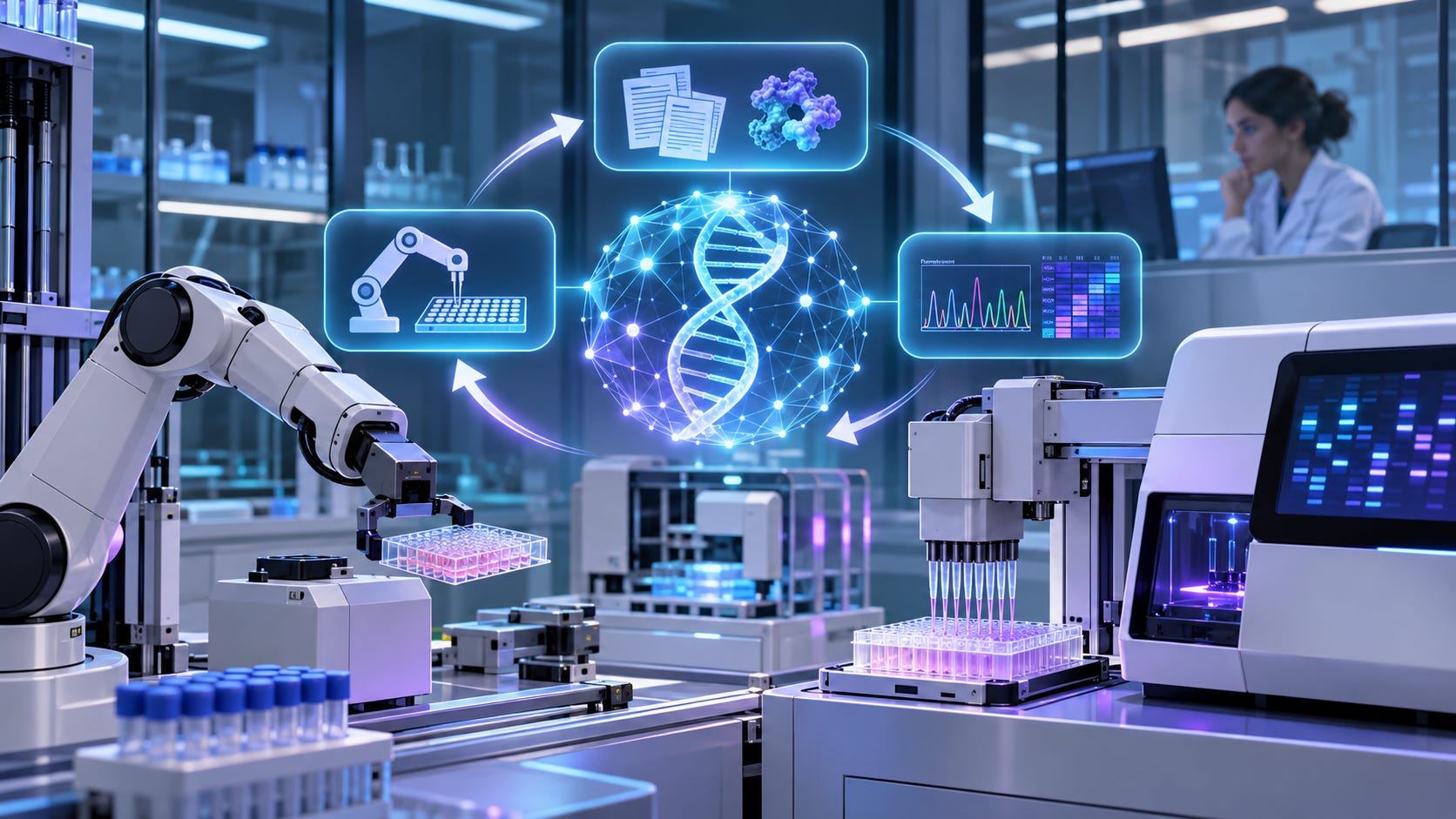
AutoDNA executed over 11,000 physical operations in DNA synthesis, amplification, transcription, sequencing, data storage, and mutation detection. This was far more than a single robot executing a carefully programmed pipetting protocol. AutoDNA integrated experimental planning, software generation, lab execution, and data analysis into a single system.
But the question of whether AI “ran a biology lab” brings up a more complicated question:
What does it mean to “run a lab”?
Why wet-lab biology is hard to automate
AI already does many scientific tasks that are entirely in the computer. It can search literature, predict protein structures, analyze gene-expression data, generate code, and suggest molecular designs. But wet-lab biology is different because physical materials are unpredictable.
Materials can evaporate, break down, get contaminated, and stick to plastic. A robot needs to know how fast to suck up viscous liquids, whether it needs to cap a tube, and what to do if a pipette tip doesn’t attach. It might have to interact with a centrifuge, a thermal cycler, a liquid handler, a sequencer, and a robotic arm, which may all have different interfaces and command systems.
And then there’s tacit knowledge, practical information that may not be recorded in a published protocol. For example, the protocol might say to incubate for 30 minutes, but it might not mention that a low-volume sample should be capped right away. Experienced scientists automatically adjust for things like this.
So a useful autonomous lab needs to do more than just follow instructions. It needs to detect failures, recover from them, and map a scientific goal to a series of physical actions.
How AutoDNA works
AutoDNA was designed as an AI-native lab. This means that the models, software, robotics, and experimental workflows were built to work together, rather than being separate tools that were later linked.
A user specifies an experimental goal. Then specialized agents break down the task. For example, one agent searches the literature, another plans the protocol, another manages reagents, another generates executable code, and others interface with hardware. A scheduling system manages the use of different instruments. Lower-level software manages precise robotic actions.
This separation is important because large language models are probabilistic. This makes them good at planning and interpretation, but not so good at directly controlling every time-sensitive action. So AutoDNA uses AI to generate and refine plans, but then uses conventional automation software to reproducibly execute many physical actions.
The system also represents laboratory instruments with standardized capabilities. Rather than requiring the AI to understand the interface of each manufacturer’s instrument, the software describes the capabilities of each instrument. For example, it might say that an instrument can heat a plate, transfer liquid, or sequence DNA.
What the system actually did
Researchers tested AutoDNA with different experimental tasks.
For example, AutoDNA optimized enzymatic DNA synthesis. It achieved an average stepwise yield of about 97.8 percent, which is similar to a human-optimized protocol. In another experiment, AutoDNA scheduled four protocols in parallel. It executed them about 3.2 times faster than if they had been executed sequentially (Wu et al., 2026).
The longest demo was for DNA data storage. Digital information can be converted into sequences of the four DNA bases. These sequences can be synthesized as physical DNA molecules. Then they can be recovered by sequencing the DNA.
AutoDNA encoded a sentence into 78 strands of DNA. It synthesized the DNA sequences, managed the workflow, sequenced the products, and reconstructed the original message. This took over eight days and involved 11,382 hardware actions.
Humans still restocked reagents, replaced disposables, disposed of waste, and fixed some failures that the system couldn’t handle. But the system managed the overall workflow and automatically recovered from some equipment failures.
The system also analyzed a sample of a colorectal tumor. It detected a possible mutation in KRAS G13D. It designed primers to test this result. It synthesized the primers. And it experimentally confirmed the mutation. It wasn’t an autonomous clinical diagnosis, but it showed a meaningful feedback loop. One result led to the next physical experiment.
Scientific reasoning or sophisticated execution?
AutoDNA clearly automated a lot of experimental execution. But it didn’t autonomously decide which scientific questions to ask.
Humans specified the problems, designed the lab, chose the equipment, set up parts of the workflow, defined safety boundaries, and interpreted the larger meaning of the results. The AI was operating in a scientific and physical environment that humans had carefully set up.
This is an important distinction. There’s a difference between optimizing a known protocol and discovering a new biological principle. AI systems are particularly good when the success of a task can be measured with an objective. For example, can you increase enzyme activity, improve yield, or reduce cost?
But open-ended research is harder. Scientists often don’t know what measurement will distinguish the best explanation. And sometimes, unexpected observations are important because they don’t fit the original objective.
So AutoDNA is more like an autonomous experimental operator than an independent scientist.
How this fits in a larger trend
AutoDNA is part of a larger trend toward self-driving labs.
For example, previous systems like SAMPLE used machine learning and automated experiments to navigate protein sequence space and find more stable enzymes (Rapp et al., 2024). Other platforms have integrated protein language models with robotic biofoundries to improve enzyme activity through repeated design-build-test-learn cycles (Singh et al., 2025).
And AI-agent systems have automated some scientific reasoning. For example, the Virtual Lab used a team of agents to design SARS-CoV-2 nanobodies. Then human researchers produced and experimentally tested them (Swanson et al., 2025).
These systems automate different parts of science. Some reason but don’t touch the lab. Others run experiments, but within objectives defined by humans. The long-term goal is to bridge these two layers.
The remaining problems
Autonomous labs introduce other challenges besides technical performance.
For example, reproducibility is more complicated because language models are probabilistic. And they can change between versions of software. So a trustworthy system needs to track model versions, prompts, generated code, execution logs, instrument states, and every human intervention.
Biosecurity is another issue. If a platform can design experiments and synthesize DNA, then it needs user verification, sequence screening, hardware limits, audit trails, and human review for higher-risk work.
And there’s a risk of deskilling. If scientists only interact through a natural-language interface, they might lose enough practical knowledge that they don’t know when an automated system is giving a plausible but incorrect result.
What changed my view
The headline that humans only entered the lab to empty the trash was an exaggeration, but it pointed to something real.
AutoDNA didn’t replace the scientist. It shortened the distance between experimental planning and physical execution. It could take an idea generated by AI, turn it into code, execute it with lab equipment, analyze it with real data, and modify it in another experimental cycle.
The lab of the future probably won’t be empty. It will still need biologists, engineers, technicians, safety experts, and people who can recognize unexpected results.
But what might change is what those people do.
Maybe scientists won’t do as many repetitive transfers. Maybe they’ll spend more time choosing questions, designing assays, interpreting failures, and deciding which observations are worth another experiment.
But that’s not science without humans.
It’s a new division of scientific labor.
References
Wu, M., Wang, Z., Wang, J., et al. (2026). “An AI-native experimental laboratory for autonomous biomolecular operations.” *Nature*. https://doi.org/10.1038/s41586-026-11228-6
Rapp, J. T., Bremer, B. J., & Romero, P. A. (2024). “Self-driving laboratories to autonomously navigate the protein fitness landscape.” *Nature Chemical Engineering*, 1, 97-107. https://doi.org/10.1038/s44286-023-00002-4
Singh, N., Lane, S., Yu, T., et al. (2025). “A generalized platform for artificial intelligence-powered autonomous enzyme engineering.” *Nature Communications*, 16, 5648. https://doi.org/10.1038/s41467-025-61209-y
Swanson, K., Wu, W., Bulaong, N. L., Pak, J. E., & Zou, J. (2025). “The Virtual Lab of AI agents designs new SARS-CoV-2 nanobodies.” *Nature*, 646, 716-723. https://doi.org/10.1038/s41586-025-09442-9