

I want you to think about something for a second. Have you ever heard a sound, a smell, or a song, and felt your stomach drop for no reason you could name? Like some part of your brain remembered something bad, even when your conscious mind forgot all about it?
That’s not random. That’s your amygdala doing exactly what it was built to do: hold onto fear like it’s the most precious thing in the world. Because evolutionarily speaking, it once was. And the wild thing is, scientists at Radboud University in the Netherlands just published research in Science Advances that shows we might be able to change how that process works using nothing but sound waves.
I spent weeks digging into this paper, and honestly it changed the way I think about fear, trauma, and what it even means to “get over” something scary. So let me walk you through it, because I think it deserves way more attention than it’s getting.
What the Amygdala Actually Does
The amygdala is a small, almond-shaped structure sitting deep inside both hemispheres of your brain. It’s part of the limbic system, which is basically your brain’s emotional control center, and it’s one of the oldest structures we have from an evolutionary standpoint. According to the National Center for Biotechnology Information (NCBI, NBK537102), the amygdala processes emotions, especially fear, and it’s heavily connected to the hypothalamus, which is what triggers your body’s physical stress response.
When you perceive a threat, your amygdala fires first. It signals your hypothalamus, which signals your adrenal glands, which dump adrenaline and cortisol into your bloodstream. Your heart rate spikes, your muscles tense, your pupils dilate. Harvard Health Publishing calls this the “fight-or-flight” response, and it happens in milliseconds, long before your prefrontal cortex, the part of your brain that actually thinks, gets a chance to process what’s going on.
What I find genuinely fascinating about this is that the amygdala doesn’t wait for you to decide something is scary. It decides for you. It acts on incomplete information at incredible speed, because in the evolutionary context where this system developed, waiting to think cost you your life. Your brain essentially said: I would rather you panic over a stick that looks like a snake than get bitten by an actual snake while you’re still deliberating. That logic makes total sense for survival. The problem is we carry that same system into a world where our “threats” are exams, social situations, and memories of things that have already ended.
How the Brain Actually Learns Fear
To understand what the researchers did, you first need to understand Pavlovian conditioning. Most people know this from the famous dog experiment where Pavlov rang a bell every time he fed his dogs, and eventually the dogs started salivating at just the bell, with no food present. The bell became a conditioned stimulus (CS), something that triggers a learned response even though it was originally completely neutral.
Your brain does the exact same thing with fear. According to a 2015 review in PMC on Pavlovian conditioning and associative learning, the brain runs three major circuits covering defense, feeding, and reproduction, and each one has its own mechanisms for learning associations. The defense circuit is the one we care about. When something bad happens alongside a neutral stimulus, your brain links them together. Now that neutral thing carries a threat signal, even when the original threat is completely gone.
Here’s the part that I think is genuinely underappreciated: all three of those circuits share a common structural feature. There’s a negative feedback loop where the conditioned stimulus activates a pathway that then dampens the reinforcing unconditioned stimulus. Basically, your brain is constantly doing predictive threat management. Its ability to do this fast and efficiently is arguably what kept the human species alive long enough to build civilization. But the same efficiency that makes it work so well is also what makes fear so hard to shake when the system misfires.
This is the core problem for people with PTSD, phobias, and anxiety disorders. The conditioned stimulus keeps triggering the fear response long after the actual threat is gone. The brain learned the lesson and won’t unlearn it. That’s what the Radboud researchers wanted to understand and potentially change.
The Experiment
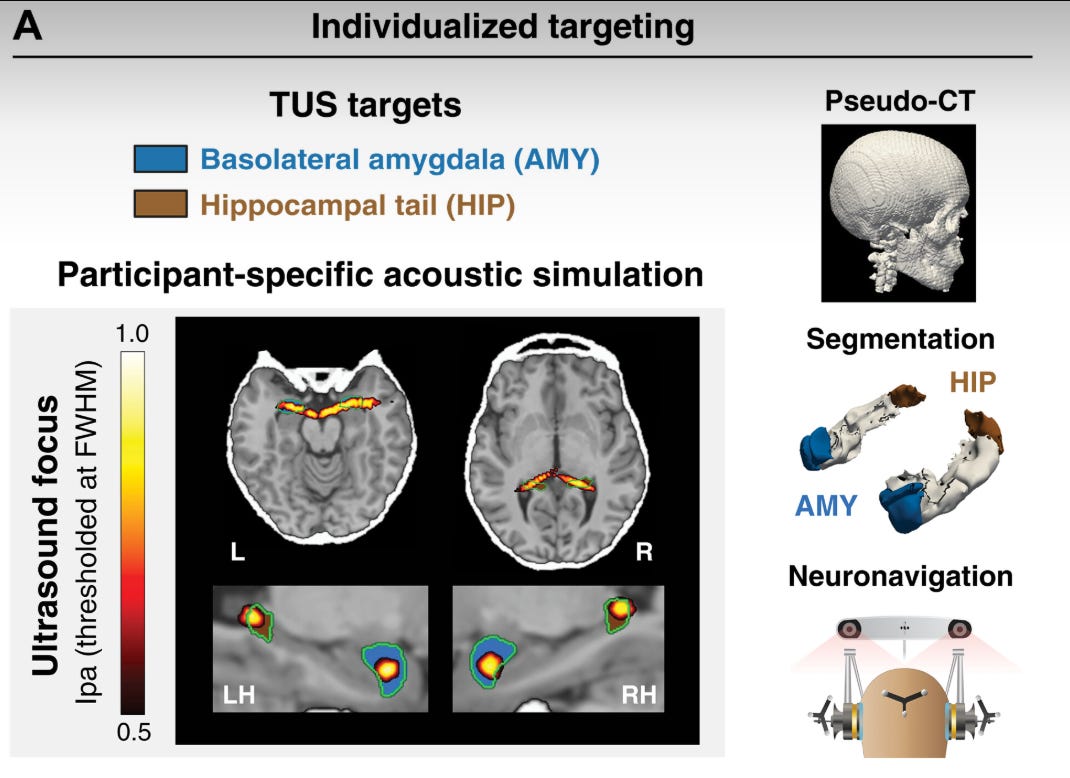
The researchers used a technology called Transcranial Ultrasound Stimulation, or TUS. It’s non-invasive, so no surgery, no implants, nothing going into anyone’s brain. Low-intensity acoustic sound waves are directed through the skull at a specific brain region. I kept trying to wrap my head around this when I first read it, because the idea that you can aim sound at a specific structure deep inside the brain and change what it’s doing, without touching anything, feels like science fiction. But it’s not. The protocol followed ITRUSST safety recommendations, which is an international expert consensus on safe TUS parameters, so participants weren’t at any medical risk.
They recruited 50 participants total, split into two experiments of 25 each. Before anything else, every participant got an MRI scan so researchers could pinpoint exactly where their amygdala and hippocampus sat, because brains differ from person to person and the precision here really mattered
.
Then came the snakes. A red snake image was the CS+, meaning it appeared alongside a mild electric shock 50% of the time. A green snake was the CS−, shown just as often but never followed by a shock. The green snake was the safety signal. Participants wore a device on their heads delivering either real TUS or sham TUS, which is fake stimulation with no actual ultrasound. They didn’t know which one they were getting. This is basically the neuroscience equivalent of a placebo condition, and it’s critical for making the results trustworthy, because if you think something is happening to your brain, your behavior changes even if nothing actually is.
Fear was measured using skin conductance response, or SCR, which tracks the tiny changes in sweating that happen when you’re stressed or scared. The researchers were upfront that SCR is a proxy for fear rather than fear itself, it varies between people and doesn’t capture what someone is actually feeling subjectively. But it’s one of the most reliable physiological measures available for this kind of research, and it gives you something objective to track across 120 acquisition trials.
What Actually Happened, Phase by Phase
The experiment moved through five stages, and the progression really is a story if you think about it.
During acquisition, which was 120 trials of seeing the snakes with and without shocks, participants in the sham condition showed normal fear learning. Their skin conductance responses went up for the red snake and stayed flat for the green one. This confirmed the basic experiment was working and that people were actually learning the threat association. Nothing surprising yet.
After a break came retention, just four trials with TUS turned off entirely. Participants still feared the red snake. The fear memory had consolidated. It didn’t fade on its own just because time passed. This is the thing that gets me every time I think about it, because it’s so counterintuitive to how we talk about fear in everyday life. We say things like “you just need time” or “you’ll get over it,” but biology doesn’t really work that way. The brain holds on specifically because letting go could be dangerous. A threat you survived once is worth remembering.
Then came extinction, which was 40 trials where the shocks stopped entirely. Participants kept seeing the red snake, nothing bad happened, and slowly their SCR responses dropped. This mirrors what therapists call extinction learning, and it’s actually the scientific basis of exposure therapy. You confront the feared thing in a safe context repeatedly until the association weakens.
After that, reinstatement: three sudden unannounced shocks. The fear came back fast. This is called fear reinstatement, and it’s one of the most clinically frustrating things about anxiety treatment. The fear that faded during extinction wasn’t actually erased. It was just suppressed. The original memory stayed underneath, and it took almost nothing to reactivate it. That’s why PTSD relapses happen. That’s why a single triggering event can undo months of therapy progress. And understanding that gap between “extinction” and “erasure” is honestly one of the most important things I took away from this whole project.
Finally, re-extinction: they ran extinction again. The fear faded, and this time it faded faster.
Whats Really Interesting
In Experiment 1, TUS was aimed at the amygdala. In Experiment 2, it targeted the hippocampus as an active control, same procedure, different brain region, so the researchers could make sure any effects they found were actually specific to the amygdala and not just a generic result of pointing ultrasound at someone’s head.
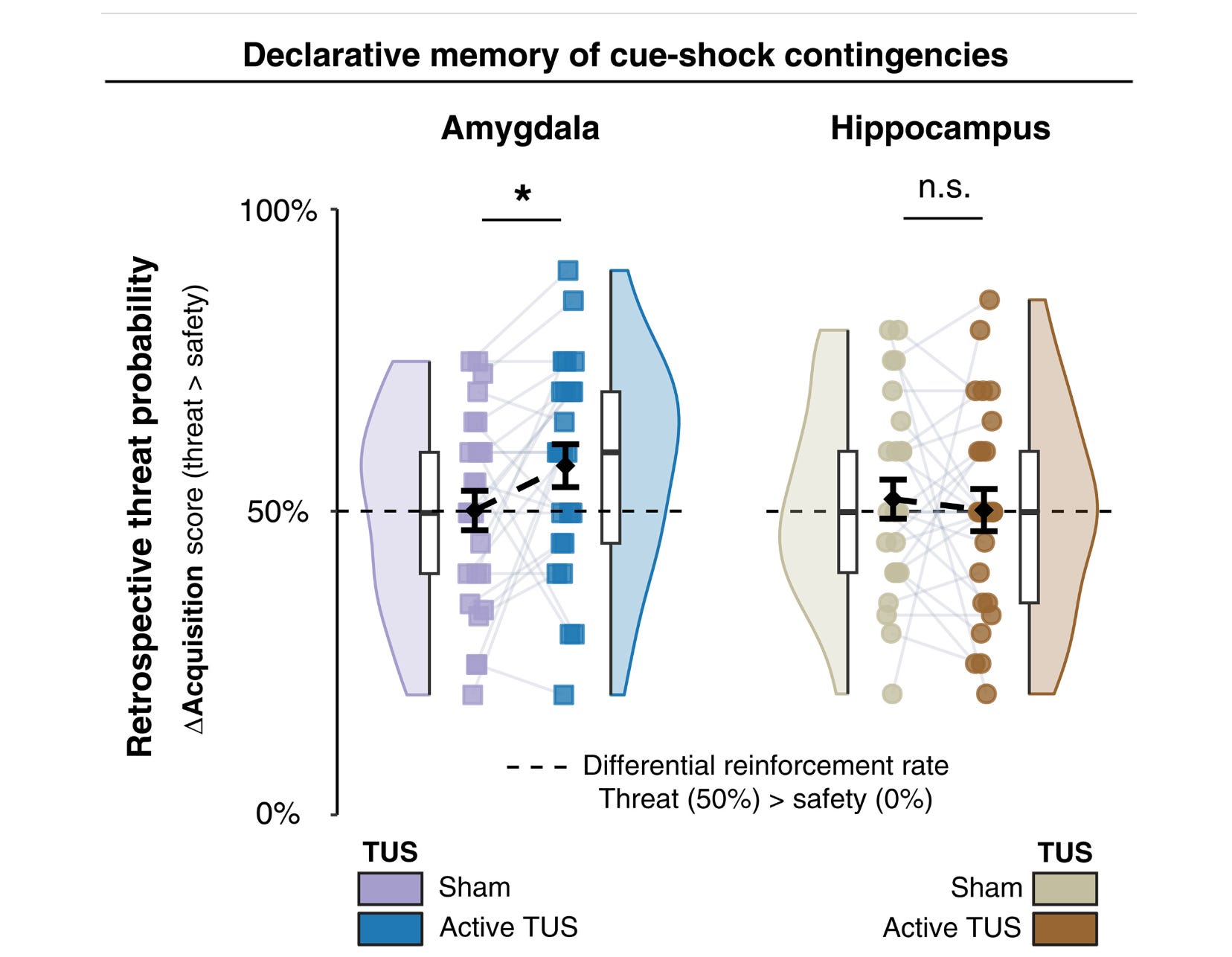
When the amygdala was disrupted with real TUS, three specific things happened. Early threat acquisition slowed significantly, with a reported effect of t(24) = -2.98, P = 0.0065, Cohen’s d = -0.60. Then, when shocks stopped, those threat memories extinguished faster during early extinction: t(24) = -2.81, P = 0.0097, Cohen’s d = -0.56. And participants became less accurate in their retrospective estimates of how often they’d been shocked: t(24) = 2.14, P = 0.0427, meaning they overestimated the shock rate even as their behavioral fear was changing.
When the hippocampus was targeted in Experiment 2, essentially none of this happened. No parallel learning effects. This matters a lot because it means the amygdala finding isn’t just noise, it’s specific to that region.
The researchers also used computational modeling to go deeper than just the behavioral results, and this is genuinely the part of the paper I find most conceptually exciting. The model found reduced acquisition learning rates, increased extinction learning rates, and a drop in what the authors call “emotional learning bias,” which is the brain’s built-in tendency to weight threatening experiences more heavily than safe ones. They describe the amygdala’s natural role as putting the brain into a state of “learning fast, forgetting slow.” When you disturb that state during the formation of a new fear memory, you get the opposite pattern: the fear forms more slowly, and it releases more readily when you try to extinguish it later.
The idea that the amygdala isn’t just an alarm bell but is actually setting the brain’s entire learning policy during threatening situations is something I had to sit with for a while before it clicked. It’s not just reacting to fear. It’s deciding how deeply the brain should engrave the experience. And the fact that you can adjust that dial with sound waves, at least in a controlled lab setting, feels like a genuinely new kind of knowledge about how the brain works.
Possibilities
The World Health Organization estimates that 1 in 4 people will experience a mental health condition at some point in their lives. PTSD specifically affects around 3.9% of the global population according to Our World in Data, which is hundreds of millions of people carrying fear memories that their brains refuse to update, even when the person desperately wants to move forward.
The standard treatments, cognitive behavioral therapy and exposure therapy, work by essentially doing extinction manually. You confront the feared stimulus in a safe context over and over until the fear response decreases. But as this study makes clear, extinction doesn’t erase the original memory. It creates a competing one. The original threat association is still there underneath, which is why reinstatement works, and why real-world patients relapse after triggers.
What I keep thinking about is this: if TUS could be used during exposure therapy to make extinction faster and more durable, it doesn’t replace the therapy. It just makes the therapy work better, for people for whom it currently doesn’t work well enough. The Radboud University press release specifically suggested that if a fear memory is reactivated, amygdala-targeted stimulation during that window might help the memory update more quickly. That’s still hypothetical. But it’s a real hypothesis grounded in real mechanistic evidence, and it’s a lot more scientifically honest than the usual “scientists found a way to erase fear” headline that this kind of research attracts.
The researchers also mentioned the possibility of an ear-worn device that could reduce how much fear gets encoded from a moment in real time, kind of like a passive intervention that sits in the background while someone is going through exposure therapy. I don’t know if that’ll work in practice. But the fact that it’s a plausible direction based on what the amygdala actually does is interesting in a way I didn’t expect this project to get to.
Limitations
The participants were healthy adults. The study explicitly excluded people with psychiatric disorders and snake phobias. The fear was entirely lab-made, 120 trials of seeing snake images and occasionally getting a mild shock, which is genuinely not the same thing as surviving something traumatic. Sample sizes were 25 people per experiment, which is small enough that we have to be careful about how broadly we apply the conclusions. And skin conductance responses are a proxy, not a direct readout of subjective fear or clinical symptoms.
Most importantly, TUS in this study was applied during fear acquisition, while new memories were being formed. It hasn’t been tested on fear memories that already exist. For someone who already has PTSD from something that happened years ago, we don’t yet know if targeting the amygdala during a reactivation window would help, hurt, or do nothing. The paper explicitly calls this out as the essential next step. And one more thing worth saying clearly: the protocol required individualized MRI-based brain targeting, acoustic simulations, specialized bilateral transducers, and expert safety oversight. This is not a DIY intervention. It’s a tightly controlled lab procedure.
What I Actually Walked Away Thinking
Before this project, I think I understood fear mostly as a feeling. Something you experience, something you work through, something therapy helps you manage. What I didn’t fully appreciate was how mechanical it is at the biological level. There are specific brain structures, specific phases of learning and extinction, specific computational properties that determine how sticky a fear memory becomes. The amygdala isn’t just producing a feeling. It’s running a learning algorithm, and that algorithm has parameters.
The part that genuinely changed something for me is the “learning fast, forgetting slow” framing. Because I’ve always wondered why fear is so much easier to acquire than to lose. Why one bad experience can rewire how you feel about something for years, while months of positive experiences barely make a dent. And the answer, at least partially, is that the amygdala is specifically designed to make that asymmetry happen.
Knowing that this mechanism is identifiable, targetable, and potentially adjustable doesn’t make me think fear is fake or that trauma isn’t serious. It actually does the opposite. It makes me take it more seriously, because now there’s a specific biological explanation for why it’s so hard to shake. And if there’s a specific mechanism, there might eventually be a specific way to help people whose brains are stuck in “learning fast, forgetting slow” long after the threat has passed.
Sources: Science Advances, “The human amygdala in threat learning and extinction,” Radboud University (DOI: 10.1126/sciadv.aea8233); Radboud University Research Release (March 25, 2026); Neuroscience News (March 30, 2026); NCBI (NBK537102); Harvard Health Publishing, Understanding the Stress Response; PMC, Pavlovian Conditioning and Associative Learning (2015); WHO Mental Health Atlas; Our World in Data, PTSD Prevalence; ITRUSST Biophysical Safety Consensus (Aubry et al., 2023); IFCN-endorsed ITRUSST Practical Guide (Murphy et al., 2024).