

As you get older, your cells don’t turn into something new. A muscle cell in an 80-year-old is still a muscle cell, but it doesn’t behave the way it did when that person was 20, and scientists are still trying to figure out exactly what changed.
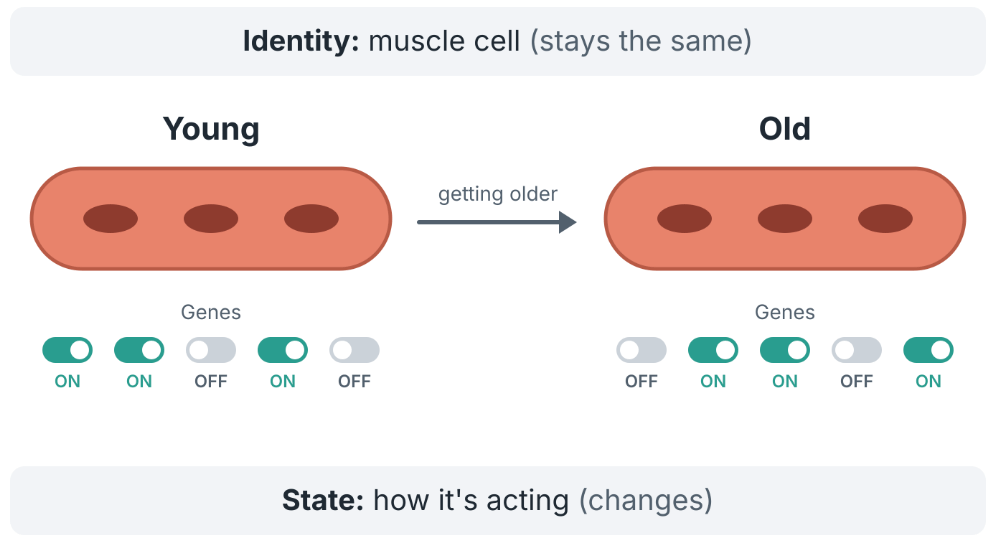
Akanksha Sachan, a fifth-year Ph.D. student in computational biology at Carnegie Mellon University and the University of Pittsburgh, describes this as a change in the cell’s “state.” A cell’s identity is what kind of cell it is, like a muscle cell or an immune cell. Its state is more like its condition, or how it’s acting at a given moment. The identity stays the same, but the state can shift over time.
“All of our tissue cells, they age,” Sachan said. “They’re not changing identity, but they’re still changing their state.”
Sachan builds computer models to figure out what causes those shifts. In one project, her models pointed to a single enzyme that seemed to be behind some of the changes in aging muscle, and when a lab tested that prediction, the muscle started to look younger.
I talked with her over Zoom in October about that project, how she got into this field, and what she thinks AI can and can’t do for biology.
From engineering to cells
Sachan didn’t plan on studying biology. She majored in chemical engineering as an undergraduate in India, where computational biology was still a small field. She got curious about how cells work and decided to switch, even though the biology she knew at that point was, in her words, “just high school level.”
Computational biology turned out to be a good fit. Instead of running experiments at a lab bench, computational biologists work with data on a computer, looking for patterns that explain what’s happening inside cells.
For Sachan, a lot of that data comes down to genes. Every cell in your body carries the same DNA, which is basically a huge set of instructions, but each cell only uses some of those instructions at a time. Which genes are switched on or off shapes how a cell behaves, so when a cell’s state changes, its gene activity usually changes too. Newer technology lets scientists measure this inside each individual cell.
That creates a lot of data. “Each data point is around 40,000 to 800,000 dimensions, and then you have millions of cells,” Sachan said. Put simply, every single cell comes with tens of thousands of measurements, and one study can include millions of cells. Nobody could look through all of that by hand, which is why her field relies so much on AI. The models search for which genes are changing and, if things go well, help explain why.
One enzyme, one switch
One of the projects Sachan was most excited to talk about is one she has been working on for the past two years with a wet lab, which is what scientists call a lab where experiments are done with real cells and animals. Sachan is co-advised by two scientists, Jishnu Das, who runs a computational group, and Aditi Gurkar, who runs a wet lab at Pitt.
Studying aging in animals usually takes a long time, since you have to wait for them to get old. To speed things up, Gurkar’s lab works with mice whose DNA has been damaged on purpose so they age faster than normal. That makes them a useful way to see what goes wrong in aging muscle.
Sachan compared muscle from those mice with muscle from healthy mice, focusing on the fibers you use when you sprint. She ran the data through machine learning models to look for anything that was working differently in the aging mice.
The models kept pointing to one enzyme, called pyruvate dehydrogenase kinase. An enzyme is a protein that helps a reaction happen in the body, and this one has an important job.
“It’s an enzyme that basically controls if your cell’s metabolism is going to consume glucose or it’s going to consume fat,” Sachan said. “It’s a switch between these two metabolic pathways.”
In the aging mice, that switch wasn’t working the way it should. But at that point it was only a prediction, and the only way to know if it was right was for Gurkar’s lab to test it. When the researchers got the switch working again, the muscle changed, including the amount of muscle fiber.
“They were looking more like young,” Sachan said.
Before this project, almost all of her work had been on the computer, so seeing one of her predictions hold up in a lab was new for her. “I thought the impact is way higher if you can see in wet lab if your predictions are working,” she said, “if people are excited about what you have discovered.”
Changing a cell without erasing it
The mouse project fits into a bigger goal of Sachan’s. If scientists can figure out what changed inside a cell, she wants to know whether they can push it back, or toward a different state entirely. That idea is called re-engineering cells.
Scientists have done a version of this before. Shinya Yamanaka won a Nobel Prize for finding a way to wipe a cell’s identity clean and turn it back into a stem cell, a blank-slate cell that can grow into almost any other kind. Sachan is interested in a gentler approach, where the cell changes its state but stays the same type of cell.
She has already tried this with B cells, a kind of immune cell. When a B cell runs into a germ, it can go one of two ways. It can remember the germ so your body fights it faster next time, or it can make antibodies to fight it right away. Sachan’s team looked for the genes that decide which way a B cell goes, and when collaborators tested some of those genes in the lab, they really could steer the cells one way or the other.
When I asked how this kind of work might eventually help regular people, Sachan brought up Ozempic. It started out as a type 2 diabetes drug, but now a lot of people take it to lose weight and lower their chances of getting heart disease or diabetes later in life.
“People are just doing a lot of different drugs, not just because they’re sick, but because they want to prevent something,” she said.
She thinks cell engineering could be used the same way someday, to prevent disease before it starts. She’s careful about how far it should go, though. “Gene knockout is very invasive and should only be done if you have a genetic disease,” she said, referring to permanently shutting off a gene. Smaller changes in how cells use their genes can happen through something as ordinary as diet. People already get diet advice for that reason, she said, “but this doesn’t work for everyone.”
The virtual cell
Since so much of her work depends on AI, Sachan also had opinions about where the field is going. A lot of people working on AI in biology want to build what they call a “virtual cell,” a computer model of a human cell so detailed that it could predict how the cell would react to anything. In theory, you could use it to solve disease.
Sachan doesn’t think that’s going to happen. “I don’t believe that,” she said. “I am not a believer of solving all diseases.”
She does think models can predict what happens to a cell when you change something about it, like turning off a single gene. That’s the same idea behind Perturb-seq, a type of experiment I wrote about in an earlier post. But even then, she said, the predictions need lab experiments to back them up. “It has to go hand in hand.”
My own predictions
That stuck with me because of my own research. This past summer I worked in Dr. Sagar Khare’s lab at Rutgers, designing protein binders, which are proteins built to stick to a specific target. By the end I had 27 designs that looked promising according to AlphaFold3, a program that predicts the shape of proteins, and our other checks. None of them have been tested in a lab yet, so for now they’re just predictions, the same place Sachan’s enzyme was before Gurkar’s lab tried it out.
I told Sachan that I like the computational side of biology a lot more than lab work, and I still do. But her mouse project is pretty much what I hope happens with my designs someday, where the model makes a specific guess and then someone actually goes and checks it.
Of course, plenty of guesses don’t hold up once someone tests them. When I asked Sachan what she had learned from her own path, from engineering to biology and from the computer to the wet lab, she said it was resilience.
“You’re bound to fail a lot of times, but then few times it works,” she said. “And then the few times that works is when you learn, okay, this is how it works.”